


After the Corona Pandemic: Back to Business
(08.07.2021) In an interview with Wirtschaftliche Nachrichten/IHK Aachen, Dr. Christian Coppeneur-Gülz, Managing Director of WWM GmbH & Co. KG, talks about the trade fair business during the Corona pandemic and the solutions WWM brought to market during this time. Source: www.aachen.ihk.de
And suddenly trade fairs were banned: How did the Corona pandemic affect the event industry? A visit with Dr. Christian Coppeneur-Gülz, Managing Director of WWM GmbH & Co. KG, based in Monschau.
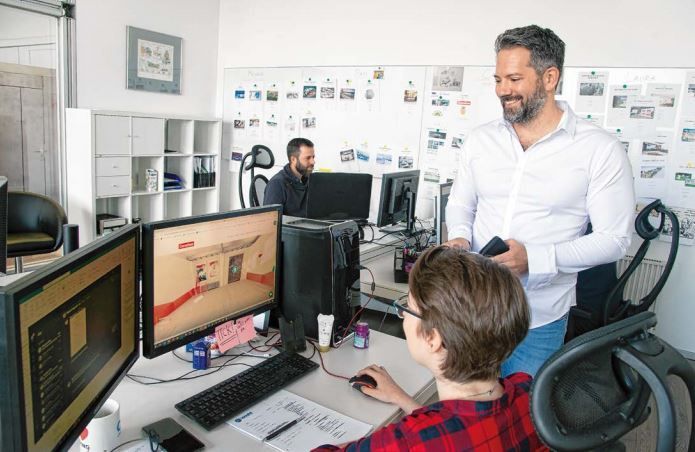
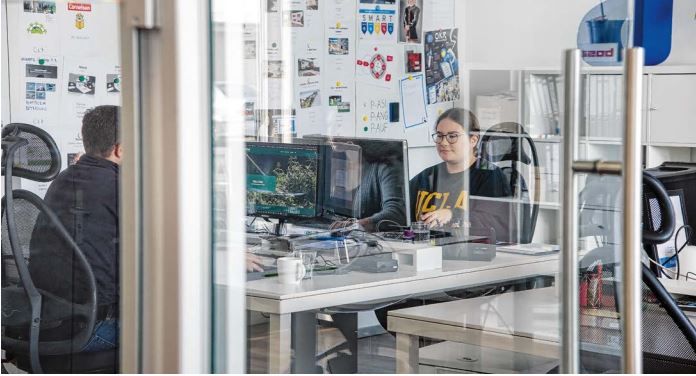
When virtual worlds are created, it happens right here: in an old warehouse in Imgenbroich, where everything is somewhat reminiscent of the Google office style. Cables hang from the ceiling, along with a few large black lights, and there are several screens on each of the white tables. Next door, a 3D artist is rebuilding a rocket station that will soon host a three-day event – all digitally, of course. Cornelsen is also getting an elaborately designed virtual brand space with a brick look, where up to 2,000 teachers regularly receive training in webinars. “On certain event days, we reach up to 30,000 hours of content distribution,” says Dr. Christian Coppeneur-Gülz, Managing Director of WWM GmbH & Co. KG.
In 2005, the doctor of business informatics – who is also a member of the IHK plenary assembly – took over the exhibition stand construction company from his father; in 2016, he opened the “WWM Lab”, and at the beginning of 2019, he founded ExpoCloud GmbH. Coppeneur-Gülz’s idea: to attack WWM’s old business model with a small team of ten employees and rethink it completely. Now the “Lab” has successfully carried the medium-sized company through the crisis: “That was our turbo during the pandemic,” emphasizes the 40-year-old as he makes his way through the still dormant large-format printing plant, past the many pallet spaces for the trade fair equipment, to the meeting rooms, which at WWM are called “Lagerfeld”, “Warhol”, “La Chapelle” or “Newton”. In an interview with Wirtschaftliche Nachrichten, Coppeneur-Gülz talks about sleepless nights, innovative trade fair formats and the value of personal encounters.
Wirtschaftliche Nachrichten: How did you experience the pandemic months? In exhibition stand construction, business collapsed completely right at the beginning.
Dr. Christian Coppeneur-Gülz: In March 2020, trade fairs were banned – that is like a ban on practising your profession. You can no longer do your job. At the time, digital business accounted for ten percent of our sales. That means: if around 90 percent disappears from one day to the next, you have a business problem.
Wirtschaftliche Nachrichten: What happened next at WWM?
Dr. Christian Coppeneur-Gülz: What was available immediately was the short-time working programme: all companies in the industry – including WWM – had to make use of it. Without the programme, it would not have worked at all, but it only helps to a limited extent. At our logistics hub in Alsdorf, for example, we employ almost 30 people who suddenly had nothing to do. But the fixed costs that keep running at a company of this size are still considerable. March, April and May were very tough. Then came the first bridging aid: it was simply structured and helped us. You always hear on the market that the aid did not arrive – but I cannot confirm that. We applied for the aid and received it.
Wirtschaftliche Nachrichten: What was the mood like in the company?
Dr. Christian Coppeneur-Gülz: Of course, there were discussions about when things would start again. In March 2020, I actually told our people: it’s the flu, everything will be back in the autumn – don’t worry. But then you realise: normality is not returning, we won’t be back in business that quickly.
Wirtschaftliche Nachrichten: When did interest in your digital solutions take off?
Dr. Christian Coppeneur-Gülz: From May 2020, inquiries rose rapidly – in fact, we had never had as many inquiries for our digital products and services as in spring 2020. It’s just that nobody ordered.
Wirtschaftliche Nachrichten: Why not?
Dr. Christian Coppeneur-Gülz: Companies realised: live communication is not possible right now, we have to switch to digital – but how does that even work? In April and May, I worked and was on the phone twelve hours a day – from one call to the next, from Asia to America, explaining to people how it works. Our good fortune was that we had already developed the products and were already on the market. But nobody ordered. The hope was probably still: we’ll go on holiday in July and August, and when we come back, the old world will be back. Because that wasn’t the case, orders came pouring in in September!
Wirtschaftliche Nachrichten: How did the company manage to prepare for the big rush in digital?
Dr. Christian Coppeneur-Gülz: We looked at what resources we had in the company. Some of our current 3D artists previously designed our physical exhibition stands – a demanding task! They moved from exhibition stand construction and design to the new unit and now create the virtual worlds there. ExpoCloud also transferred people so that we could manage the know-how transfer quickly. As early as September, we were able to reduce short-time work for certain groups of employees and topped up the salaries of all employees on short-time work to one hundred percent – that was a very, very important step. Because what we all overlook: there are employees, warehouse staff for example, who have now been on short-time work for well over a year. That is not only a psychological problem for them, but also a financial one. We also had resignations in the spring – employees who said: we’re sorry, we don’t know what’s going to happen, and we have a family to support. Since September, we have had virtually no staff turnover.
Wirtschaftliche Nachrichten: After the shock in March 2020: when did the feeling return that – at least from a business perspective – the world was back in order?
Dr. Christian Coppeneur-Gülz: Towards the end of the year, at Christmas, we knew: no matter what happens now, we are back in business – despite the ongoing fixed costs in classic exhibition stand construction. We realised that, thanks to digital, we would even emerge stronger from the crisis in the long term.
Wirtschaftliche Nachrichten: Has the pandemic led to digitalisation in the industry overall?
Dr. Christian Coppeneur-Gülz: The pandemic did not lead to digitalisation, it accelerated it. Digitalisation was already there. That applies to many areas of life: without the pandemic, nobody would ever have asked whether we can teach pupils online or whether employees can work entirely from home. It simply wouldn’t have been done. But we can see that it is possible. We have been offering customers our digital solutions in ExpoCloud for two years, but they wanted to keep relying on the real, physical trade fair – which I don’t question either. It makes sense. People weren’t ready yet – nobody wanted to risk going digital.
Wirtschaftliche Nachrichten: What will remain after the crisis? Pupils return to school, but the exhibition stands stay in the virtual world?
Dr. Christian Coppeneur-Gülz: We believe that by the end of the crisis, digital will account for more than 30 percent of our business. The physical trade fair will not disappear. We could have done this interview via MS Teams – but a lot gets lost that way. But: the trade fair will change. Germany, with its large exhibition grounds, stands for the IAA and the Hannover Messe. This concept will decline; instead we will move towards what I call a “trilogy”, a congress format. There are lectures, so I can continue my education, there is an accompanying exhibition with small stands, and there is an area in the congress hotel where I can network. Successful events – and a trade fair is a form of event – have exactly this trilogy of “education”, “exhibition” and “networking”. So we will see classic trade fairs become smaller. And this development plays right into WWM’s hands – we have never built 10,000 square metre stands. We feel very much at home in the range below 500 square metres; that is exactly our world. And in our opinion, that’s where things are heading.
Wirtschaftliche Nachrichten: What is missing when the trade fair business runs purely digitally? Personal encounters?
Dr. Christian Coppeneur-Gülz: Some meetings we used to travel for, we now hold via MS Teams. And that’s not worse at all – it’s good. Corporations will no longer say: for a one-hour meeting you’ll drive to Hamburg, ideally with an overnight stay, and drive back the next day. But if the constant personal exchange, which is so important, no longer takes place, we look for events where we can meet. That’s why we believe live communication has to come back – because we want to see each other! We want to talk, have a drink, network. That’s why I’m convinced it will return, and I even believe we will see growth in small congress formats. On the one hand, the big IAA topics will be pushed down into this format, and on the other hand, field sales customer visits, to give one example, will push up into this area from below. It’s important to understand that the crisis did not cause a technological disruption from state A to state B – such as, to put it simply, from the carriage to the car. Rather, state A was banned, so only B was possible, even though B is not better, just different from A. At some point, state A will return, but B will remain because it also has advantages and strengths. I believe that in future you will have to play on both fields – you have to master both the “real” and the “virtual”. Neither will disappear.
Wirtschaftliche Nachrichten: Exhibition stand construction has long lead times: a stand is often commissioned as soon as the current trade fair is over. How can the restart succeed?
Dr. Christian Coppeneur-Gülz: The “Alarmstufe Rot” (Red Alert) campaign that went through the media showed that the event industry is Germany’s sixth-largest economic sector – with 130 billion euros in turnover and more than one million employees. The bad thing is that this industry was the first to close, and it will be the last to come out of this phase. Because, just as you say, a trade fair like the IAA has a twelve-month lead time: I place the order twelve months in advance, and then it is executed. If customers have no certainty that the trade fair will take place, they won’t place the order. But we hope that the first test balloons will take place this autumn, so that the major clients say: I’ll take the risk. The signal has to go out: there is a trade fair, it was planned and it was held! For a year now, all we have known is “planned and not held”. Now we need “planned and held” so that the market can start up normally again in 2022. The legal situation – in March, April and May 2020 I had to deal almost exclusively with these issues – was as follows: if a customer orders an exhibition stand worth half a million and the organiser says the trade fair cannot take place, this does not constitute force majeure. For that, there has to be an official cancellation by the authorities – and that didn’t come until May. That was a dilemma for exhibitors, organisers and stand builders. Now, in the autumn, trade fairs may take place again – but here too, from a legal point of view, someone has to be responsible if they cannot take place after all.
Wirtschaftliche Nachrichten: Was there a project during the pandemic months that was particularly rewarding or particularly exciting?
Dr. Christian Coppeneur-Gülz: That’s hard to say, because two hearts beat in my chest: a real one and a digital one. We were particularly pleased that, at the turn of the year, we won our biggest customer ever in conventional exhibition stand construction. Unfortunately, we can’t do anything for them at the moment, but that will come. In digital, an internationally operating pharmaceutical company that has been using our digital solution since 2020 has now decided to roll it out globally. That’s a bit like being knighted.
Wirtschaftliche Nachrichten: Digital will account for more than 30 percent of your business after the crisis, and the old world is coming back too. What growth do you expect in 2022?
Dr. Christian Coppeneur-Gülz: If the old business comes back next year, we expect company growth of 20 to 30 percent. The anticipation is already building – it’s going to be great! At the same time, it will put the company under pressure – after all, we moved almost 20 percent of our employees into the digital areas. We have already asked whether employees would like to return to the old, analogue area once the crisis is over, but they say: “Do I have to?” They feel at home there and want to stay. So we have to scale extremely quickly and figure out where to get the resources. We have now advertised many full-time positions and apprenticeships in web design, media design and product design for our Monschau and Alsdorf sites, and we need to fill them. That’s why we’re glad if the trade fair business starts up slowly in the autumn.
Wirtschaftliche Nachrichten: 2020 was an emotional roller coaster – how did you cope personally?
Dr. Christian Coppeneur-Gülz: In the first weeks and months, I slept very badly. But you are still an entrepreneur and have to motivate people. That’s the challenge: in the early days you go home and could cry, and the next day you’re standing here again with a smile on your face, saying that things will start again soon – that something will happen again! And you don’t actually have that certainty. But what motivated me enormously is that the ideas we had, which nobody wanted before, are now working – that is of course extremely satisfying. Above all, we have so many intelligent, capable people in the company who can rethink, who are highly motivated themselves and completely open. The crisis has shown us: we are one of the most agile companies in the industry – exactly in the way I always imagined and wished for.
Wirtschaftliche Nachrichten: Some companies in the industry have certainly fallen by the wayside …
Dr. Christian Coppeneur-Gülz: In one of my university lectures, I said: when a market changes very, very rapidly, there will always be winners and losers. That’s easy to say when you’re explaining to students that change is an opportunity! But when I stood there in April with my back against the wall, it wasn’t so easy anymore. Yet that is basically what happened: if you go with the current requirements, you can make a big difference in a situation like that. The sad thing is that many great and competent companies in the industry couldn’t switch to digital solutions that quickly or didn’t have enough liquidity to wait for the bridging aid. That’s when some players disappear from the market – and not necessarily the bad ones.
Wirtschaftliche Nachrichten: In 2016 you set up a “Lab” with the task of rethinking the business model. Does the innovation process suffer under the pressure of now having to be profitable?
Dr. Christian Coppeneur-Gülz: For us, “Always challenge the old ways” is a classic theme of our culture. When we started the “WWM Lab” and ExpoCloud, we told the team they didn’t have to be profitable. That’s bold in a free market economy, of course, but WWM was strong enough to afford such a small unit. By the way, that doesn’t mean people are less productive. But it is precisely this freedom that is needed to digitally challenge the existing rules or habits of an industry. I wouldn’t say there was any pressure to make it work now – it was already working. Rather, people have now seen that what we developed wasn’t just a gimmick, but that there are customers who pay money for it. Of course, at some point the time will come when we need to set up a second Lab – because the original idea of attacking and rethinking things has become reality. The Lab is now operational, part of the organisation, developing products that are being bought. After all, there’s that saying: “The success of the present is the worst thing that can happen to you for the future.” That reminds me of a conversation with a board member of a German engineering company. He said: “We have 10,000 employees and I’m not afraid of the competition at all. I’m afraid of two students in a shared flat in Berlin who don’t know the rules of our industry and break them.” These are exactly the rule breakers we need!
By Anja Nolte