Trade Show Exhibitor: Goals, Planning, and Success
 Maxima Matara : Friday, 11. September 2026
Erfahren Sie, wie Aussteller mit klaren Zielen und professioneller Planung ihren Messeauftritt erfolgreich gestalten.
4 min read
How to Plan the Size, Layout, and Equipment for a Successful Trade Show Presence
Thoughtful trade show booth design is essential to the success of your exhibition appearance. In this article, you'll learn how to determine the right booth size, strategically plan the layout, and select the appropriate equipment. With practical tips from industry experts, we'll show you how to attract visitors, generate more leads, and make your trade show presence measurably successful.
Trade shows are one of the most important platforms for medium-sized industrial companies when it comes to acquiring new customers, maintaining networks, and presenting their brand. Yet the reality is that many trade show appearances fall short of their full potential.
Why?
Because booth design is often not planned strategically enough.
As an experienced exhibition stand builder, we have supported companies for many years in planning and implementing successful trade show booths. We know what matters—and we're happy to share that knowledge with you.
A successful trade show booth design ensures that your company gains visibility, sparks interest, and initiates valuable conversations. It combines design, functionality, and strategy into a cohesive visitor experience.
In short:
A good trade show booth attracts people; a great one converts them into customers.
The ideal booth size depends heavily on your objectives and your offering.
Don't make your booth too small. Generous space feels more inviting and enables high-quality conversations. Particularly in industrial environments, clearly structured areas are beneficial: presentation, interaction, and consultation zones should be logically separated.
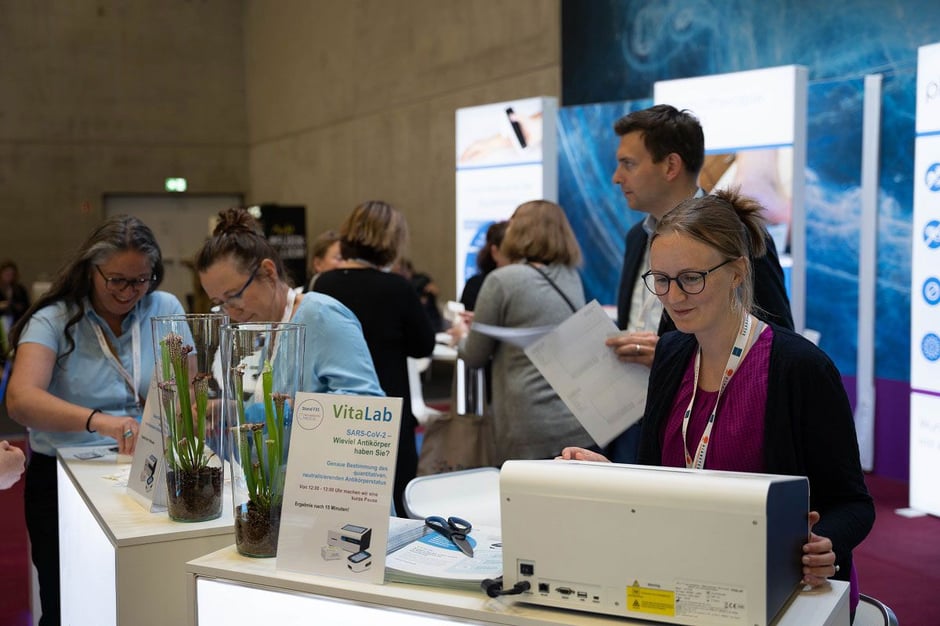
An active trade show booth by terraplasma medical
A successful trade show appearance starts not with design, but with strategy.
Ask yourself:
Example:
Instead of aiming to “collect contacts,” set a goal such as:
“40 qualified leads per trade show day.”
This allows you to align all other decisions toward achieving that objective.
The size of your booth significantly impacts how your company is perceived.
Focus on balanced planning with clearly defined functional zones.
A professional booth layout ensures visitors can intuitively navigate your stand.
Imagine this:
A visitor sees your booth, instantly understands what it's about, and naturally steps closer.
That is exactly the goal of a well-thought-out booth layout.
The design characteristics of your booth determine success or failure within seconds.
Reduce complexity. Less is often more—especially in a busy exhibition hall full of impressions and distractions.
A clear focus ensures that visitors remember your message.
The equipment and furnishings of your trade show booth influence both functionality and the visitor experience.
Your team is the most important element of your trade show appearance.
Even the best booth design only works if your employees actively engage with visitors.
Your trade show appearance doesn't end when the booth is dismantled.
A truly successful exhibition presence is proven during the follow-up process.
Important:
Leads should be followed up within 48 hours after the trade show at the latest.
At a trade show, you're competing with hundreds of exhibitors for attention.
Visitors make a decision within seconds:
A strategically designed trade show booth ensures that you make the right impression at exactly that moment.
As an experienced exhibition construction partner, we know how to successfully combine strategy and design.
Our Goal:
Your trade show booth should do more than impress—it should deliver results.
Professional trade show booth design doesn't happen by chance. It is based on clear goals, strategic planning, and the seamless integration of size, layout, and equipment.
By considering these factors, you'll create a trade show presence that:
Would you like to strategically optimize your next trade show appearance and maximize your results?
Together, we'll develop a customized concept that puts your goals at the center of the planning process and professionally brings your exhibition stand to life.
Contact WWM today for a no-obligation consultation and start planning your next trade show appearance early.
 Maxima Matara : Friday, 11. September 2026
Erfahren Sie, wie Aussteller mit klaren Zielen und professioneller Planung ihren Messeauftritt erfolgreich gestalten.
 Maxima Matara : Friday, 3. October 2025
Erfahren Sie, wie Sie mit klaren Zielen, Profi-Support und flexiblen Tools einen erfolgreichen Messeauftritt planen.

Discover how the AIDA model is used in trade show booth design to attract visitors, spark interest, and encourage successful conversations.