 Hasan Meydan
Robotics at the trade fair booth: Efficient & Interactive
In today's digitalized trade fair world, companies face the challenge of not only informing their visitors, but also inspiring them. Traditional...
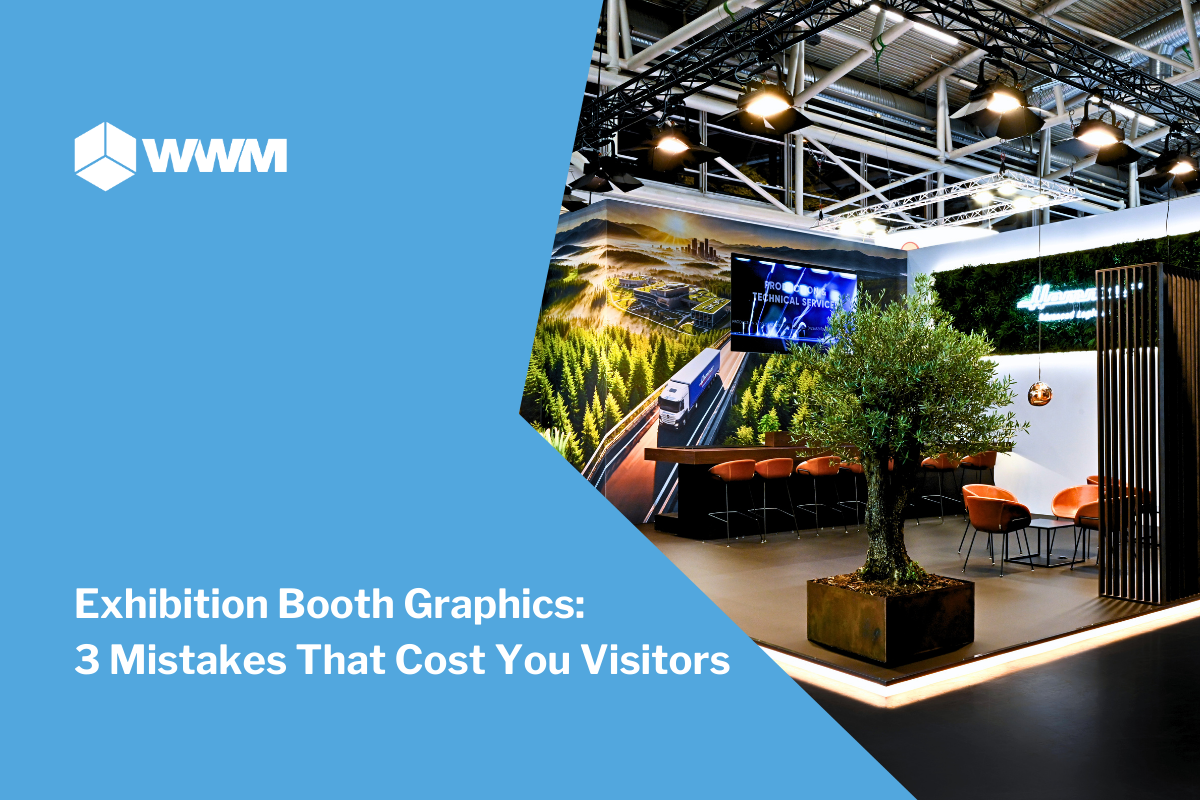
A trade show booth is a significant investment: booth rental, design, graphics, setup, technology, and, last but not least, staffing all cost time, money, and nerves. This makes the scenario familiar to many companies all the more frustrating: despite great products and dedicated staff, visitors simply walk right by without stopping.
The reality on the trade show floor is clear: the battle for attention is decided in a matter of seconds. Often, the problem isn’t the product itself, but the visual communication—that is, the graphics on the trade show booth.
Many still think, “More is better.” In practice, this often has the exact opposite effect. In this article, we’ll show you the three most common graphic design mistakes that drive visitors away and the right solution for each one to make your trade show booth significantly more effective.
A common mistake is that companies simply copy their entire corporate brochure onto the trade show wall. Long blocks of text, detailed product descriptions, and comprehensive company information are meant to explain everything possible.
The reality is different: A trade show visitor’s attention span is less than three seconds. In the hectic trade show environment, no one stops to read lengthy texts. Instead, a feeling of being overwhelmed sets in; the eye can’t find a clear focal point, and the visitor feels overwhelmed by the flood of information.
Think of your booth graphics like a poster, not a book.
The key question is: Can the core message be grasped in passing?
The details belong in a personal conversation, not on the wall.
Images shape first impressions, and this is precisely where many mistakes occur. Often, images are used that are technically unsuitable or lack meaningful content.
Images from the internet often have too low a resolution for large-format prints. When printed, they appear blurry and low-quality. At the same time, interchangeable stock photos are frequently used, which fail to evoke emotion and make the booth seem generic.
Another classic mistake is incorrect placement: Important motifs, logos, or messages are located in the lower third of the wall and disappear behind counters, furniture, or visitors.
Subconsciously, the viewer draws conclusions about the quality of the offering based on its visual presentation—often to the exhibitor’s disadvantage.
Focus on high-quality visual storytelling.
This way, your booth isn’t just seen—it’s noticed.
.jpeg?width=1920&height=1076&name=AdobeStock_1310902342%20(Gro%C3%9F).jpeg)
Many trade show booths focus primarily on themselves: market leadership, tradition, technical details, or internal product names dominate the design.
For the visitor, the crucial question remains unanswered: “What’s in it for me?”
Instead of clear statements, confusion arises. Technical jargon and cryptic terms are off-putting; technical features are listed without explaining the concrete benefits.
If the visitor doesn’t understand within a few seconds what problem is being solved here, they won’t invest time in a conversation.
Clearly place your value proposition at the center.
The clearer your message, the lower the barrier to approaching you.
Compelling trade show graphics don’t happen by chance. As an experienced trade show design partner, WWM GmbH & Co. KG guides companies from the initial concept through to the final implementation, with a keen eye for what truly works at trade shows.
If you’d like to know whether your current booth graphics attract visitors or tend to deter them, please feel free to contact us. We’ll advise you honestly, practically, and as equals.
-1.png)
In today's digitalized trade fair world, companies face the challenge of not only informing their visitors, but also inspiring them. Traditional...

 Maxima Matara : Friday, 5. June 2026
When you think about your next trade show appearance, what comes to mind first? Your product? Your innovation? Your services? That is perfectly...
 Sascha Corban : Friday, 20. March 2026
From Concept to Success: Why Preparation Is Key When you think about your next trade show booth, an image likely pops into your head right away:...