 Hasan Meydan
Successful customer webinars on Microsoft Teams
 René Meures : Friday, 5. July 2024
Erfahren Sie, wie Kundenwebinare zu Messeständen über Microsoft Teams und Technikprodukte den Messeauftritt optimieren
Everyday planning in trade fair construction is characterized by high time pressure. Projects have to be implemented faster and faster, deadlines are tight, and changes are almost part of daily business. Customer requirements evolve, stand areas change at short notice, or individual elements have to be adjusted, often shortly before approval.
At the same time, we repeatedly see in practice that designers and planners spend a large part of their working time on repetitive tasks. Small adjustments such as “Make the table 10 cm wider” or “Make the wall half a meter higher” seem trivial at first glance, but quickly add up to a considerable time factor. These routine tasks not only slow down the workflow, but also cause frustration within the team.
Especially in trade show construction, where efficiency and precision are crucial, this raises a key question: How can recurring tasks be reduced without compromising quality and flexibility?
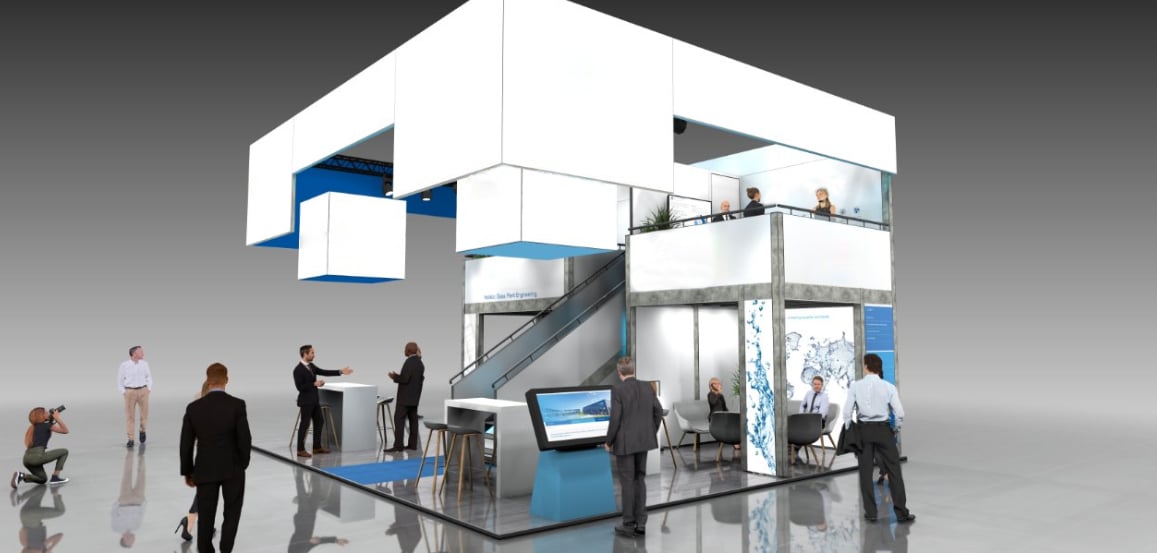
In many companies, everyday life still looks like this: A standard component, such as a trade fair wall, a shelf, or a counter, is remodeled for each project or laboriously copied and adapted from old projects. What could actually be standard is constantly being rethought and rebuilt—at least digitally.
The disadvantage is obvious: highly qualified specialists invest their time in simple routine tasks instead of concentrating on design, functionality, and creative solutions. This not only costs time, but also money. At the same time, there is less room for what ultimately makes a trade fair stand truly successful: a well-thought-out design and a clear brand message.
Another major problem is manual data maintenance. In many cases, a 3D model consists solely of “dumb geometry.” Dimensions, materials, item numbers, and prices must be transferred separately, often manually, to Excel lists or calculation tools.
This inevitably leads to errors: typos, transposed numbers, or outdated data creep in. The consequences usually only become apparent later in the process, in the form of incorrect orders, production problems, or inaccurate calculations. Corrections cost time, nerves, and, in the worst case, money.
The parameterization of 3D libraries addresses precisely these weaknesses. The basic principle is simple: instead of recreating each component over and over again, all employees access a central, verified library. These components contain all the important information such as dimensions, variants, and properties, which can be flexibly adapted without having to redesign the model.
The great benefit lies in standardization. The entire company's know-how, i.e., how something is built, is stored directly in the 3D component. It is no longer stored only in the minds of individual employees, but is available to the entire team.
For us, this means consistent quality across all projects, regardless of which planner is currently working on the design. At the same time, queries from the workshop are reduced because clearly defined and proven components are used.
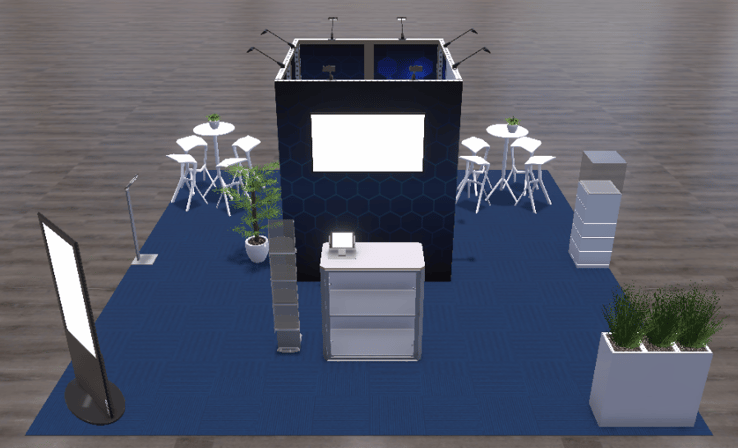
Another key advantage of parametric models is the continuous data flow. Modern 3D components contain not only geometry, but also relevant metadata such as material, weight, or price.
The result: parts lists, cutting plans, or quotation bases can be generated almost at the touch of a button. Media breaks between planning, calculation, and production are reduced, and processes mesh seamlessly.
The 3D library thus becomes the backbone of the entire process chain. It not only serves to create appealing visualizations, but also actively supports the economic and technical implementation of a trade fair stand, from the initial idea to production.
Of course, setting up a parameterized 3D library requires a certain amount of effort at first. Components must be clearly defined, tested, and structured. But this investment pays off exponentially in the long term.
Routine tasks are automated, sources of error are reduced, and processes are accelerated. At the same time, there is more freedom for creative work and individual solutions, precisely where real added value for the customer is created.
Our experience at WWM has made one thing clear: if you want to remain competitive in trade show construction, you have to use intelligent tools and create standards. Parameterization is not an end in itself, but a decisive lever for efficiency, quality, and cost-effectiveness.
We would be happy to assist you with your next trade show appearance and ensure that everything runs smoothly from the initial idea to implementation.
 René Meures : Friday, 5. July 2024
Erfahren Sie, wie Kundenwebinare zu Messeständen über Microsoft Teams und Technikprodukte den Messeauftritt optimieren
 Maxima Matara : Friday, 16. January 2026
Effizienter Messebau: So optimieren Sie Technik, Logistik und Organisation für erfolgreiche Messeauftritte
 Zarana Patel : Friday, 13. February 2026
Micro-Events am Stand steigern Besucherinteresse mit Mini-Workshops, Tastings & Live-Demos für mehr Wirkung.